















by Julian Huchtmann, Application Technologist, GNT Group, Germany
Using plant-based concentrates to deliver taste, nutrition and stable colours. Nutritious fruit, vegetable and plant concentrates can be used to deliver a complete rainbow of shades in cat and dog food products, including kibbles, baked treats and semi-moist treats.
At first glance, it might seem surprising that colour plays such an important role in petfood. After all, cats and dogs have a limited ability to perceive colour.
However, petfood is purchased by people, not pets. Pet owners make their decisions based on visual cues, and colour is one of the most powerful.
Colour helps signal quality and nutrition, with vibrant, natural-looking shades often associated with freshness and healthiness. Colour also plays a crucial role in brand differentiation. In a crowded market, products that look appealing, whether on the packaging, through the packaging, or in advertising materials, are more likely to stand out.
Just as importantly, colour consistency builds consumer trust by ensuring products look the same from batch to batch.
Natural ingredients
These visual expectations are developing alongside a broader shift towards natural and nutritious ingredients.
Today’s pet owners increasingly seek products that reflect the same values they apply to their own food choices, including naturalness, transparency and recognisable ingredients.
Recent surveys show:
- 52 percent of pet owners globally say they prioritise naturalness over health claims in petfood.
- 45 percent of cat owners and 43 percent of dog owners worldwide consider natural ingredients a crucial factor when selecting health and wellness-focused products for their pets.
- 60 percent of cat owners and 59 percent of dog owners worldwide prefer to see non-GMO formulation claims on pet products, along with the absence of artificial flavours or colours.
- 31 percent of cat owners in Germany say products with no artificial flavours or colours influence their purchasing decisions on cat food.
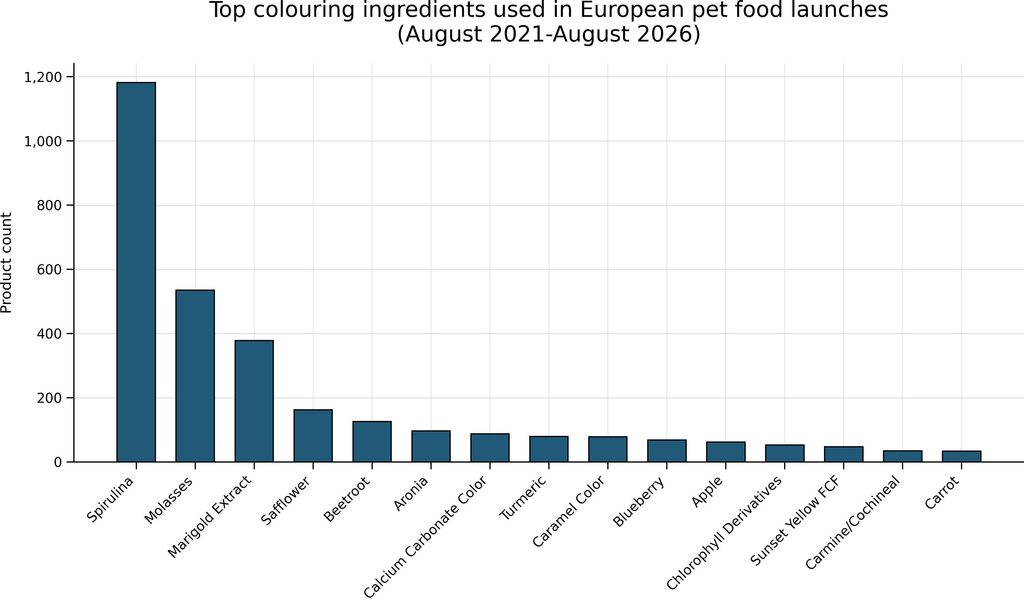
As a result, manufacturers are exploring new ways to create appealing products using colourful, nutritious concentrates derived from fruits, vegetables and plants such as spirulina, turmeric and carrots.
The Exberry Petfood Range (EU) is made from non-GMO fruits, vegetables and plants using physical processing methods and water. They are classified as complementary feed rather than feed additives in the European Union, supporting clean and transparent labelling.
Plant-based concentrates
Plant-based concentrates can be used to deliver added taste and nutrition as well as a complete spectrum of shades in applications including dry kibbles, baked treats and semi-moist treats.
These concentrates rely on the natural pigments in the raw materials. Every pigment type has its own technical considerations, and their performance can be influenced by factors such as pH, heating requirements, and light exposure.
The colour format is another important consideration. Liquids work very well in applications where other wet ingredients are used, while powders should be used in dry mixes.
To achieve optimal results, it is important to consider the characteristics of the colour type, the base product, the process, the packaging and the storage conditions.
Here, we look at some of the key considerations across different shades. The colours can also be blended to create a wide range of customised shades.
Yellow:
Yellow concentrates based on turmeric contain curcuminoid pigments, which offer excellent heat stability. This makes them particularly suitable for demanding applications such as extrusion, baking and drying.
In some cases, turmeric can deliver even more intense yellow shades following heat treatment, so it is important to evaluate products under realistic manufacturing conditions.
Another key consideration for turmeric-based colours is light exposure. Curcuminoid pigments are highly sensitive to light, so opaque packaging is important if products are likely to be stored in light conditions.
Orange:
Orange shades can be achieved using concentrates from paprika and orange carrot. These carotenoid-based pigments also provide excellent heat stability and perform well across a variety of petfood applications.
The composition of the recipe can play an important role in the final colour appearance. For example, higher fat levels can shift orange shades towards a more yellow hue. Colours should therefore be evaluated in the final formulation rather than in a simplified laboratory system.
Carotenoid pigments are prone to oxidation. Ascorbic acid (Vitamin C) is generally permitted as a feed additive in petfood and can be added to stabilise the colour.
Red:
Red radish and black carrot concentrates are based on anthocyanin pigments.
They deliver red and bluish red shades, but their performance is influenced by the pH level of the base product. Under acidic conditions, anthocyanins will display the brightest, reddest shades. As pH rises, the colour gradually shifts towards purple.
Exposure to light can also influence the stability of anthocyanin-based colours over time, making storage and packaging considerations important.
Ascorbic acid levels should be kept as low as possible, especially for long shelf-life products. This is because oxidation of ascorbic acid creates hydrogen peroxide as a by-product, which causes bleaching of anthocyanin pigments.
Manufacturers can overdose the colour dosage to compensate for anticipated fading over the shelf life.
Blue:
Blue and green shades can create striking visual impact in petfood products, but they require careful formulation.
Blue concentrates created from spirulina are based on a protein pigment known as phycocyanin. Like many other proteins, phycocyanin is sensitive to heat and acid. This means high temperatures and low-pH environments can denature the protein and damage colour stability.
Manufacturers should seek to reduce exposure times during heat treatment and avoid direct contact with any acidic ingredients during processing.
Dosages can be increased to compensate for colour loss.
Green:
Green shades can be delivered by combining turmeric and spirulina.
Brown:
Brown shades can be delivered using caramelised carrot and apple concentrates. Caramel pigments are pH-independent and have strong heat and light stability, making them suitable for a broad range of applications.
Product considerations
The impact of the colour pigments’ sensitivities varies depending on the application, formulation and processing conditions. As a result, colours should always be evaluated in the final product rather than in simplified model systems.
Across all application types, it is important to consider the base colour. While light-coloured meats such as chicken have minimal impact, ingredients such as beef liver powder will significantly darken the appearance of the product. As a result, the plant-based colour will appear darker and dosages may need to be increased.
Dry kibbles
Dry kibbles typically have a pH level between 5.5 and 6.5. Production usually involves extrusion temperatures up to 160°C followed by a drying step at a lower level. For blue and green shades, keep processing conditions short to minimise the temperature impact. Another important consideration is bulk density. Higher bulk density generally produces stronger and more intense colours, while lower-density kibbles can appear lighter and more pastel-like.
Semi-moist treats
Semi-moist treats tend to have pH levels ranging from around 4 to 6. While produced through extrusion, maximum temperatures are lower than kibbles at around 90-120°C. Nonetheless, it remains important to keep processing conditions short for blue and green shades.
Baked treats
Baked dog treats often have a pH level of between six and seven. Once the dough has been baked, the pH level can drop significantly: a 6.5 pH dough may become a 5.5 pH final product. This will influence the final shade when using anthocyanin-based colours, so results should be assessed after baking. In addition, typical baking conditions can involve temperatures of 150°C to 200°C followed by further drying at lower temperatures, so conditions should be kept short for blues and greens.
Success with plant-based concentrates
Plant-based colour concentrates can provide petfood manufacturers with a full spectrum of vibrant shades while supporting growing demand for natural, recognisable ingredients. However, they are not a plug-and-play solution and require careful formulation.
The right colour choice will depend on the desired shade, the application, the manufacturing process and the final product characteristics. With the correct approach, brands can deliver visually appealing shades that address perceptions of variability between batches.
With almost 50 years’ experience, GNT develops plant-based colour solutions and work closely with manufacturers to help them achieve stable and consistent results across a wide range of applications. This helps in ensuring that the appearance of petfood becomes a powerful tool for communicating quality, differentiation and trust.