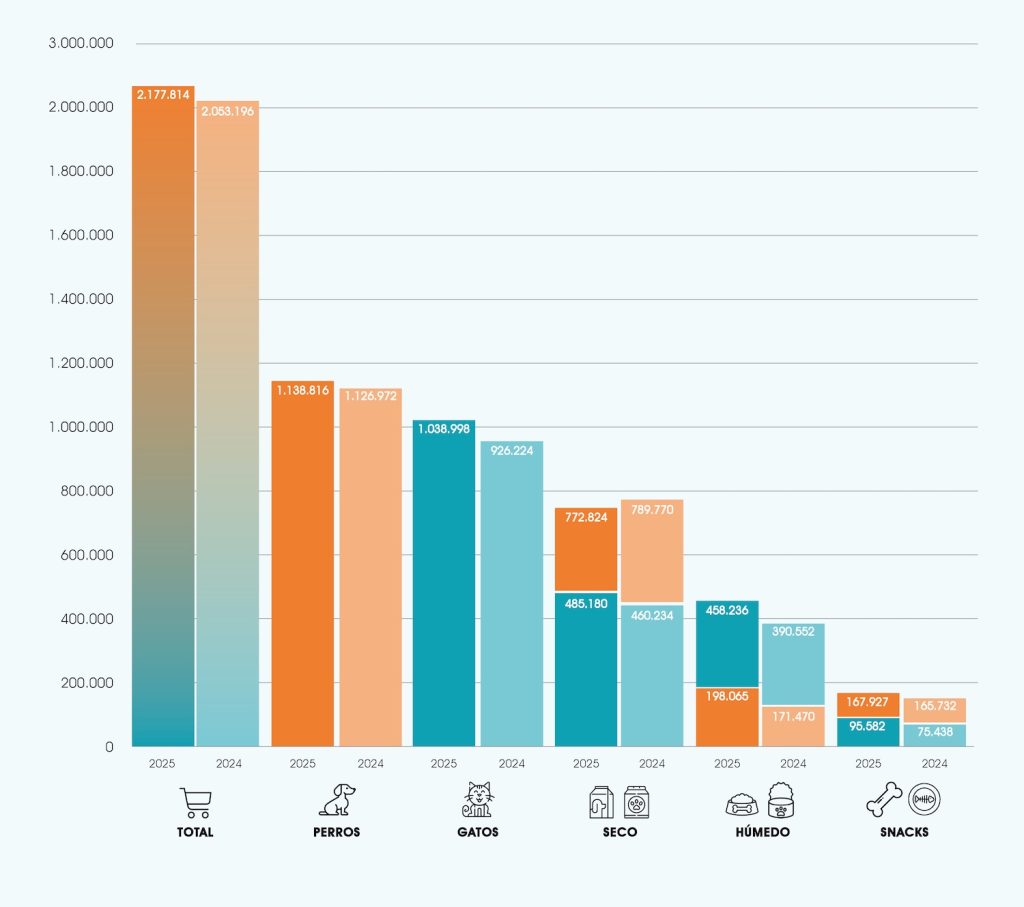
The Spanish petfood industry generated EU€2.178 billion in revenue in 2025, representing a 6.1 percent increase compared to 2024 (EU€2.053 billion), according to data from the National Association of Pet Food Manufacturers, which represents 90 percent of the sector.
Cat food continued to drive growth, with sales rising by 12.2 percent to EU€1.039 billion. Dog food also recorded a modest increase of 1.1 percent, reaching EU€1.139 billion.
With the exception of dry dog food, which declined by 2.1 percent to EU€773 million, all other categories recorded growth. Wet dog food increased by 15.5 percent to UK€198 million, while dog snacks rose by 1.3 percent to EU€168 million. In the cat segment, dry food grew by 5.4 percent to EU€485 million, wet food by 17.3 percent to EU€458 million, and cat snacks by 26.7 percent to EU€95 million.
Specialist retail and online channels continued to expand, with combined revenue rising by 4.9 percent in 2025. Wet cat food was a standout category within these channels, recording growth of 28.7 percent.
In volume terms, the industry grew by 5.3 percent to reach 603,527 tonnes. Dog food volumes increased marginally by 0.2 percent to 366,834 tonnes, while cat food volumes rose by 14.4 percent to 236,693 tonnes.
By category, dry dog food declined by 3.3 percent% to 285,711 tonnes, while dry cat food increased by 4.2 percent to 136,525 tonnes. Wet food volumes rose significantly for both dogs (+20.8%, 65,033 tonnes) and cats (+32.7 percent, 96,723 tonnes). Snack volumes fell by 5.4 percent for dogs (16,090 tonnes) but increased by 14.1 percent for cats (3,445 tonnes).
Growth in specialist and e-commerce channels (+4.2 percent by volume) was largely driven by cat food, which increased by 17.2 percent in these segments. Key export markets for Spanish production continue to include the European Union, the Middle East, the Maghreb, the rest of Africa, the Americas and Southeast Asia.

According to Santiago de Andrés, the results reflect the maturity and sustained growth of the sector, supported by ongoing innovation and a focus on meeting diverse pet needs. He added that increasing recognition of pets as family members, along with greater awareness of the benefits of pet ownership, continues to drive demand and technological advancement within the industry.