by Serhat Kemal Sari, Flexible Petfood Packaging Sales Manager, Korozo Group
Sustainability is increasingly important for the petfood industry, from the products themselves to the packaging they are sold in.
Ethically-sourced ingredients and those with a history that can be traced directly back to the farm or sea are increasingly in demand. The same is true for packaging, which is being re-engineered and constructed with a smaller environmental footprint, recyclable materials wherever possible, and overall enhanced sustainability credentials.
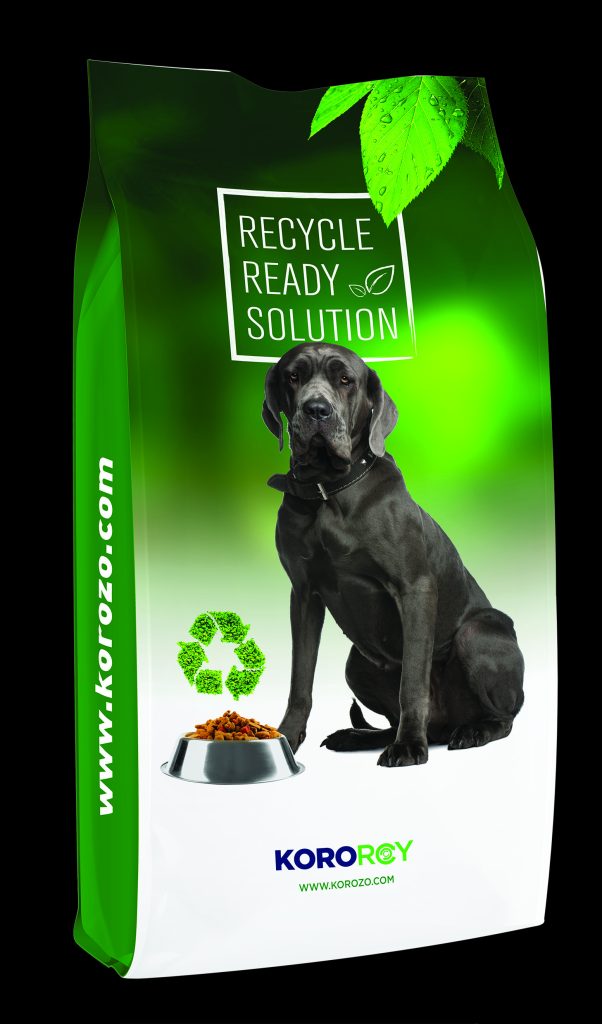
Understanding these demands and changes in the market is important for anyone serving the petfood industry. Partnering with a company that is fully versed in these changes and current demands is highly important for those seeking to deliver on their sustainability goals. With Korozo having more than 50 years of experience in the manufacture of films and flexible packaging, it is perfectly placed to fulfil this role. In recent years, this has included the development and delivery of mono-material solutions for the petfood industry. Produced in-house on state-of the-art extrusion lines, printed and then converted using cutting-edge converting lines, this combination of solutions and technologies suits and sates 21st Century consumer tastes and appetites. In high demand are those products that can integrate KoroRCY, a flexible laminated film that has been engineered with performance and recyclability in mind. From 100g flat bottom pouches up to 15kg side-gusseted bags, the inclusion of KoroRCY into petfood packaging is a major step in the right direction when it comes to sustainability of petfood packaging.
An appetite for sustainability
Consumer expectation contributes a lot to this. Pet owners, especially millennials, are noted for their willingness to pay more for sustainable products. They expect companies they buy from to prioritise sustainability in their packaging choices. The result is that pet owners often prefer brands and products that display a clear commitment to the environment. With packaging being a visible and physical commitment to sustainability, it’s often the first interaction consumers have with a brand and its efforts to protect the environment.
One of the clear consequences of this has been growing demand for “paperfication”, which has come into the petfood packaging market as it has in almost all others. However, with the need to balance environmental credentials with performance and protection of the product, the use of paper-based packaging is a challenge in petfood. This is particularly true for primary packaging and those in direct contact with the product. Petfood safety standards are some of the most stringent, so packaging has to be functional and perform as required by the product, whether wet or dry.
That is one reason why flexible packaging – stand-up and flat bottom pouches – continue to be a viable option for the industry. Laminated structures provide the necessary barrier properties that preserve the product and ensure an adequate shelf life. Lightweight in nature and resource efficient, versus labelled tins and cans at least, pouches and packs can be more user-friendly when retailing and when feeding. For retailers, specific design features allow packs to be easily and reliably displayed. For consumers, elements such as laser scoring, zippers, easy lock closures, and side handles make their use simple and convenient.
Aligning these practical considerations with the move towards sustainable packaging is what is driving the development of new material constructions. In addition, recyclability is often associated with sustainability. Packaging suppliers are responding, with the development of solutions that meet demand for fully recyclable options.
This is where mono-material constructions come in. KoroRCY is a polyolefin-based flexible laminated film that can be used in mono PE (polyethylene) structures. This compares to existing structures that might include a combination of polyethylene terephthalate (PET) and PE, metallised PET, or polypropylene (PP).
KoroRCY is designed with high performance characteristics and to be fully recyclable. It has been developed through extensive research and manufactured on the company’s in-house state-of-the-art extrusion technology. This packaging film can withstand diverse environmental conditions and has high barrier characteristics against moisture and oxygen that surpass those of traditional mixed material constructions, all while having a comparable weight and thickness. Further aligning with consumer appetite for sustainable packaging, those including KoroRCY can be supplied with a full or partial matte finish and/or the look and feel of paper.
Constructed from laminated co-extruded films, flat bottom pouches combine strength and visual appeal. They offer design flexibility with multiple webs and optional reclosure systems. A block base design ensures stability and the ability to be reliably retailed, alongside appropriate barrier properties and features that enhance useability such as easy opening, reclosability and spouts. Side-gusseted quadro pouches feature four-side sealing on two gussets, enabling both vertical and horizontal display options on shelves. These gussets expand when filled, providing additional capacity, while the product’s weight ensures the pouch remains upright. Quadro bags offer reinforced support and sealing on all sides. They are suitable for accommodating large and bulky items.
Such products are produced by Korozo on converting lines that not only deliver strength and safety with tight seals and secure gussets but provide consistency in quality during converting, so ensuring pouches and bags run perfectly on filling lines.
Flexible packaging products also work well visually. They permit complete coverage – five-side printing in the case of side-gusseted pouches and bags – so increasing the printable area and potential visual impact of petfood packaging. When coupled with high-quality printing – in up to 11 colours using flexo or gravure, as provided by Korozo alongside its film extrusion capabilities – this ensures packs are as attractive to look at for pet owners as the product inside is to eat for the pets themselves. Given the highly competitive nature of petfood and the increasing range and number of products available, this as an important part of the packaging equation that must not be overlooked and balanced with the need for sustainable petfood packaging options.
Feed the need
As well as consumer demand, pressure from within the supply chain and regulation/legislation make it essential that petfood packaging suppliers can demonstrate their own commitment to the environment and sustainability
FEDIAF, the industry body that represents the European pet food industry, has a stated commitment to the environment. It wants the petfood industry to be as resource efficient as possible and embrace technology to realise this. In the case of the development and use of packaging, FEDIAF wants to see fewer demands being made on irreplaceable resources and the development of those that can be disposed of in ways that cause minimum impact to the environment – all without loss of technological efficiency or safety. FEDIAF has also signed the EU Code of Conduct, subscribing to its obligations, such as disseminating and promoting it amongst its members to encourage more sustainable practices and explore the possibility of developing sector-specific tools and resources.
Signing up to industry initiatives are ways for a packaging supplier to satisfy this. The United Nations Global Compact and CEFLEX are just two key examples, both of which Korozo is a signatory. The United Nations Global Compact is a non-binding pact to get businesses and firms worldwide to adopt sustainable and socially responsible policies, and to report on their implementation. CEFLEX – Circular Economy for Flexible Packaging – is a collaboration of over 180 European companies, associations and organisations representing the entire value chain of flexible packaging, who are collectively working to make all flexible packaging in Europe circular. Interseroh certification is another example of how this can be realised. In the case of Korozo, certification has previously been secured for both recyclable barrier and non-barrier films. Korozo even generates its own energy efficiently and sufficiently, with two tri-generation units.
Through this, the company is able to decrease its carbon dioxide emissions into the environment, furthering its green credentials.
Collaboration is key
As evidenced, the petfood industry is seeking packaging that remains functional and practical but at the same time meets overall trends and preferences in society for more sustainable choices. Given the variety of options and end-uses, this is potentially a minefield for those seeking to actively address sustainability concerns by rethinking their packaging choices. Legislative pressures increase the complexity.
This makes collaboration across the supply chain critical and reiterates the need for packaging suppliers serving the petfood industry to clearly show their commitment to sustainability. Korozo is already doing this and is aiming to make all products it produces recyclable or reusable by 2030.
In direct relation to the petfood market, Korozo is delighted to be part of the journey towards a more sustainable future and to be collaborating with the value chain to deliver sustainable packaging choices to the petfood market.