















by Douglas Martin, CEO and Founder, MiAlgae, UK
The plant-based revolution has reshaped how we think about food, for ourselves and our pets. Walk down any premium petfood aisle and you will find labels claiming, ‘sustainable sourcing,’ ‘fish-free formulas’ and ‘plant-based nutrition.’ The messaging is compelling. But behind these claims lies a more complicated truth: there are many different forms of omega-3, and they are not functionally equal. Most are precursors to the functional omega-3s (EPA and DHA), and this is where many plant-based formulations can fall short.
The good news is that a new generation of ingredients is rising to meet that challenge, and algae is leading the charge.
The omega-3 illusion
Omega-3 fatty acids are among the most researched and marketed nutrients in human and pet nutrition. In pets, they’re associated with cognitive function, joint mobility, skin and coat health, cardiovascular support, immune strength and retinal development. For pets and owners alike, they have become a ‘must-have’ in petfood formulations that support well-being and longevity.
However, there are numerous different types of omega-3 fatty acids, and they do not all provide the same benefits.
The three principal omega-3 fatty acids are ALA (alpha-linolenic acid), EPA (eicosapentaenoic acid) and DHA (docosahexaenoic acid). ALA is found abundantly in plant oils, flaxseed, hemp and canola, and is commonly cited on petfood labels as a plant-derived omega-3 source. What those labels rarely explain is that ALA is only biologically useful if it can be converted into the longer-chain EPA and DHA. In dogs and cats, that conversion is severely limited.
In dogs, ALA-to-EPA conversion is typically below 10 percent, and ALA-to-DHA conversion falls to an insignificant level (below one to two percent). In cats, conversion is almost negligible. This means a product boasting high total omega-3 content from flaxseed oil may deliver almost no functional DHA. The label looks impressive; the biology tells a different story.
DHA, in particular, is non-negotiable. It constitutes approximately 40 percent of the fatty acids in the brain and 60 percent of those in the retina. It underpins neurological development in puppies and kittens, supports cognitive function in aging pets, plays a central anti-inflammatory role in conditions like osteoarthritis and contributes to cardiovascular, immune system and kidney health. For any petfood aspiring to deliver genuine functional outcomes, DHA must be delivered directly and not implied through ALA inclusion rates.
This is the nutritional truth about many plant-based formulations: the assumption that plant-derived omega-3s are equivalent to marine-derived omega-3s is incorrect. They are not equivalent.
Going back to the source
Fish oil has historically been the dominant source of marine omega-3s in pet nutrition. However, fish do not make DHA. They accumulate it by eating microalgae. Microalgae are the true origin of long-chain omega-3 fatty acids in the marine food chain. Every gram of DHA in a fish oil supplement has, at some point, been produced by algae.
This matters enormously, because it means algae-derived DHA is not a compromise. It’s the original source, identical to the DHA found in fish oil, absorbed and metabolised by pets in the same way, with the same functional outcomes across the same health markers. Numerous peer-reviewed studies confirm equivalent bioavailability. In a world increasingly sceptical of fish oil supply chain, cost and environmental credentials, microalgae not only replace the active ingredient but also remove fish as an unnecessary and increasingly problematic intermediate step.
A sustainability story that actually holds up
Conventional fish oil comes with a sustainability problem that is growing harder to ignore. Global fish oil supply is derived almost entirely from forage fish – anchovies, sardines and herring – sourced from fisheries that the Food and Agriculture Organisation of the United Nations (FAO) estimates are already 90 percent fully exploited or overfished. Meanwhile, demand is accelerating across aquaculture, human supplementation and premium petfood simultaneously. Industry analysts project potential deficits to grow by 20,000 tonnes per year through to 2032.
The environmental consequences extend beyond stock depletion. Forage fish are the foundational prey species for larger fish, seabirds and marine mammals. Their industrial-scale extraction disrupts entire ocean ecosystems.
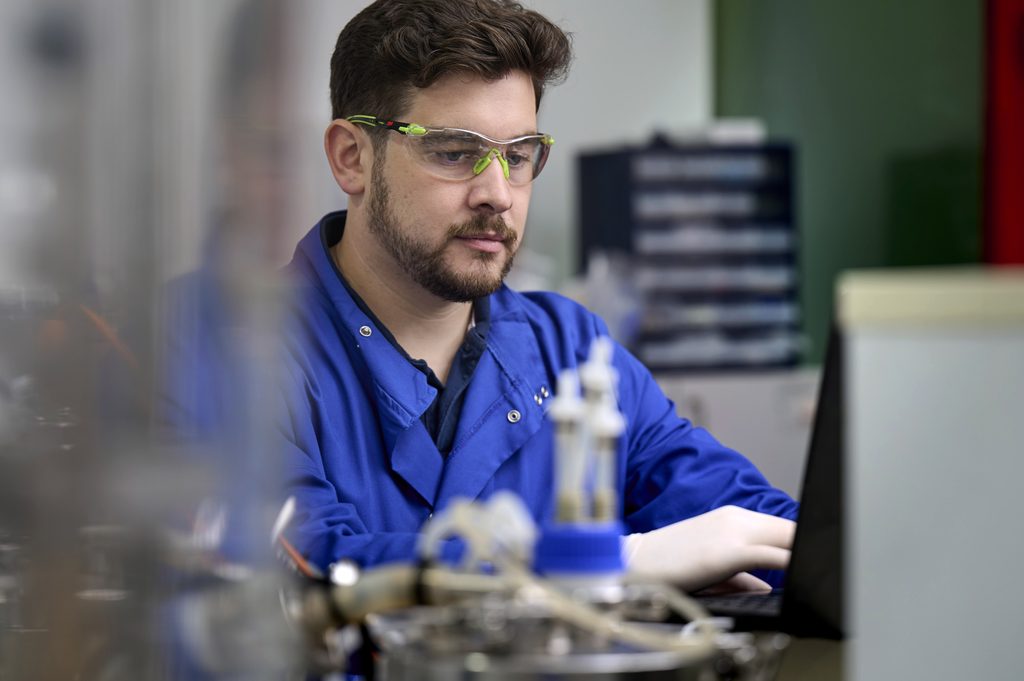
Algae cultivation operates outside this system entirely. At MiAlgae, production takes place in brewery-like stainless steel tanks, powered by renewable energy and fed by the nutrient-rich by-products of Scottish whisky distillation. The result is a circular economy model that converts an industrial by-product into a premium nutritional ingredient, with a fraction of the carbon footprint of conventional fish oil extraction, processing and global shipping.
For manufacturers and consumers seeking sustainability claims that can withstand scrutiny, algae-derived DHA offers something fish oil cannot. It can offer a supply chain that is traceable from feedstock to finished batch, locally produced, predictably priced and free from heavy metals and microplastics.
The oxidation problem
There is a third dimension to the fish oil debate that receives less attention than it deserves: palatability. Fish oil is among the most oxidatively unstable ingredients in common use. Oxidation begins the moment oil is extracted and accelerates through every subsequent stage, rendering, processing, storage, shelf life and ultimately, the bowl.
Independent market testing has found that up to 45 percent of fish oil-derived omega-3 products test positive for rancidity, and 28 percent exceed established peroxide safety limits. Oxidised oils do not just taste unpleasant; they actively undermine the nutrition they are supposed to deliver. Microalgae-derived DHA is substantially more oxidatively stable.
DHA naturally accumulates within algal cell matrices that offer inherent protection. Controlled cultivation helps preserve the algae’s integrity throughout processing and packaging, with UV-resistant, nitrogen-filled specialist bags providing additional protection. The result is an ingredient that delivers consistent, measurable DHA at the point of consumption, not just at the point of manufacture.
In palatability tests, MiAlgae’s ingredient performs well; its omega-3 DHA-rich powder is well accepted by dogs and preferred over a control diet.
Nutrition that earns the label
Microalgae is a stand-out example of an ingredient that ticks all the boxes that petfood formulators are looking for. It is plant-based, sustainably produced, oxidatively stable, contaminant-free, palatable, fully traceable and nutritionally equivalent to the best marine sources on the market.
That is not a compromise.
That is the future of premium nutrition.