by Presanthi Sithapthi, Senior Sales Manager, Veolia, South East Asia
With more than 471 million dogs kept as pets worldwide, dogs remain the most popular pet choice followed by cats with over 373 million in the world (according to the World Animal Foundation, 2024). Over the years there has been a major shift from pet ownership to pet parenting and this trend to pet humanisation has led to increased demand for high nutritional quality and dietary benefits in pet food. Pet parents are looking for natural, organic and sustainable ingredients to ensure that their pets receive a healthy and balanced diet.
This has created an opportunity for the pet food industry to incorporate alternative protein sources such as insect-based ingredients, a novel source of protein that provides functional benefits to pet’s gut health and skin.
Several studies have shown that insect meal is an acceptable alternative protein source in pet diets. Pet food companies always want the reassurance that the ingredient itself is validated by scientific research, such as feeding trials, when it comes to palatability and digestibility.
This is why Veolia, in collaboration with Chulalongkorn University in Bangkok, Thailand has recently conducted a study to assess the acceptance, general performance (feed intake and body weight maintenance) and digestibility of EntomealTM (black soldier fly larvae meal) in twenty beagle dogs and fifteen mongrel cats.
The dogs and cats were given two dry food formulations containing 10 percent and 20 percent EntomealTM, and five percent and 10 percent EntomealTM, respectively. These diets were compared to a standard commercial control diet containing poultry meat as the primary source of protein.
EntomealTM is a defatted high-quality protein made from black soldier fly larvae (Hermetia illucens) grown on traceable side streams of the food and beverage industry.
Veolia Bioconversion Malaysia Sdn Bhd, one of the largest producers of black soldier fly larvae in the Asia Pacific region, has its facility located in the north of Kuala Lumpur, Malaysia with a production capacity of 3000 tons of insect-based products per year. This industrialscale facility, which is ISO 22 000, GMP+ certified, ensures safe and consistent quality with reliable supply of EntomealTM.
In both canine and feline trials, all diets were well accepted, and body weights and feed consumption were maintained throughout the trial duration.
Acceptance and Preference
Results for the one-bowl test on dogs showed a good acceptance of dry food containing an inclusion level 10 percent EntomealTM and 20 percent EntomealTM.
Although cats are known for adapting slowly and being picky to any new diet, they consumed all the dry food presented at both inclusion levels of 5 percent EntomealTM and 10 percent EntomealTM.
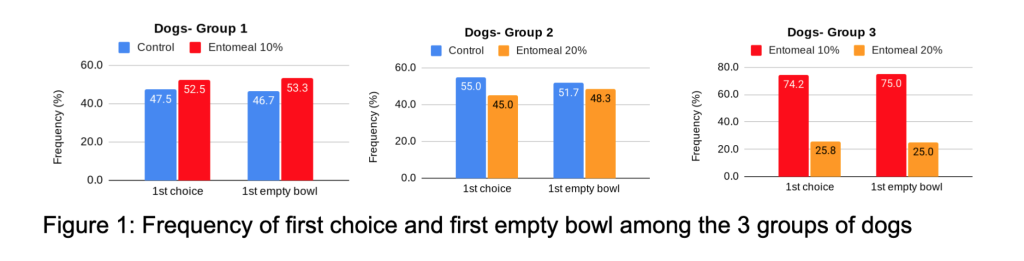
In the two-bowl testing, ‘first choice’ and ‘first empty bowl’ were observed among the three groups of paired diets. This experiment consists of placing simultaneously two bowls before the pet and we monitor which of the two foods have been approached first which is defined as the first choice. Then the bowls are left with pet until one of the bowls has been completely consumed which is referred as first empty bowl.
Results showed that dogs had no preference between the control diet and 10 percent or 20 percent EntomealTM for either ‘first choice’ or ‘first empty bowl.’
However, dogs preferred dry food containing 10 percent Entomeal over 20 percent EntomealTM (refer to figure 1).
Cats also had no preference between control diet and 5 percent or 10 percent EntomealTM, and emptying the bowl was much higher for both EntomealTM diets compared to the control diet (refer to figure 2). When comparing EntomealTM diets, cats preferred 10 percent EntomealTM inclusion versus 5 percent EntomealTM.

Digestibility
In the digestibility study, eighteen beagle dogs and fifteen mongrel cats underwent a seven-day washout period before being fed the EntomealTM diets for five days. Faecal samples were collected from the dogs and cats for analysis. The Apparent Total Tract Digestibility coefficients (ATTDC) were obtained using two methods, the total faeces collection (TFC) and chromium oxide (Cr2O3) marker, which was added at a final concentration of 0.25 percent of the diet dry matter basis.
The results showed that ATTDC of crude protein is comparable to the commercial control diet containing poultry meat, which were around 94 percent for dogs and 88 percent for cats.
Conclusion
Overall, the results of this study indicate that the palatability and digestibility of EntomealTM are comparable or better than a standard commercial pet foods for both dogs and cats.
At an inclusion level of 20 percent in dogs and 10 percent for cats, EntomealTM has an equivalent palatability to a standard commercial pet food. As a high-quality protein, EntomealTM can be easily incorporated into dry food formulations for puppies, adults and seniors to achieve optimal nutritional profiles, in addition to its sustainable benefits.
Veolia is also conducting further research with other partners to continuously improve the knowledge and positive impact of EntomealTM in pet nutrition.