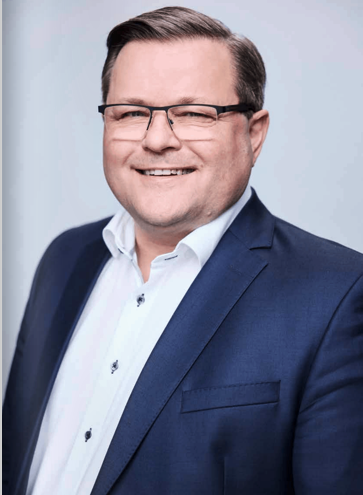
Stig joined Biomega in October 2020 after more than a decade at the specialty feed company, Hamlet Protein, where he was Vice President of Operations. Prior to his role at Hamlet Group, Stig held multiple positions across operations, sales, product and application management at several companies, including Palsgaard, Tetra Pak Filtration and Danisco (DuPont).
1.Can you share with us the journey that led you to join Biomega as CEO, particularly considering your extensive experience in the specialty feed industry with companies like Hamlet Protein and Danisco?
I have an engineering background and I started with a position as application manager with Denisco working with modifiers and stabilizers – traveling around in the world, to Latin America, around Europe, Russia, etc. And that gave me a good understanding of what was going on in the sector. The job also gave me chance to see all the other parts of the food business. And then I wanted to go frontline sales. And I got an opportunity to work with Tetra Pack for two years as a Regional Sales Manager traveling in Australia and New Zealand selling filtration equipment. That role was more aligned to my background as an engineer. And then I got a chance work for Pascal as Product Manager and this role led me to understand that I was more in the game around operations, strategy management. And then I had a chance to work for Hamlet Protein where I worked for 16 years before I came to Biomega. And I had a fantastic journey working within all disciplines. Towards the end, I was responsible for the whole value chain from raw material into delivering the final goods, taking care of labs and engineering. We were building a factory in the US and also, I was planning for a factory in China. I was approached by Biomega later and I saw that there was a fantastic opportunity for me to take another journey. And that has been amazing, things have somehow tied together from all the different positions to the one where I’m in today.
2.Biomega’s Salmigo® brand offers a unique proposition in the petfood industry with its focus on salmon peptides and oil. Could you elaborate on the process of upcycling Norwegian food-grade salmon raw materials and how it sets your products apart in terms of quality and sustainability?
The handling of the off cuts and the viscera from Salmon to use in feed has been an approach traditionally, this is mixed together adding acid and making silage. And then in the later years, there has been an interest for improving the value proposition. Biomega was one of the first players in that field, in combination with new technology, where we want to do continuous in somatic hydrolysis. And we were the first in the world and we had a patent for that for 20 years. It’s about treating the raw material in a valuable way, you should be in control of temperature, hygiene and all these parameters that control quality when its transported in and then you have to process it fast when you get it, as fresh as possible. Then you have limited degrading of the natural quality of the ingredients. And then of course, we now have a concept where we can manage a lot of raw material in a district. So we don’t need to move everything to one factory in Norway.
3.Salmigo® Protect L60 is highlighted as a highly digestible sustainable source of liquid protein with exceptional nutritional value and palatability. What inspired the development of this specific product, and what benefits does it offer compared to traditional pet food ingredients?
First of all, when we will look into the remains of salmon, it has a matrix consisting of protein structures and bones. Some of the proteins are water soluble, and some of them are not. Those which are water soluble, you can separate it out and you can concentrate them, that’s what we have done. And then you have liquid fraction with 60 percent of these proteins, that is very easy for the animal to digest. And this will give it a boost of nutrition, it has a good taste and smell. And then you can adjust the recipe. And we have not seen the full advantages of that yet. We are doing some studies together with University of Illinois, we’re looking more specific into what kind of impacts we see on the animal using this compared to some of the other sources.
4.And how do you envisage the pet food sector evolving, especially considering the increased focus on sustainability and natural ingredients in the pet food nutrition.
Petfood is a special market, it is quite similar to infant nutrition. Because it’s so crucial because you have the feed safety parameters to comply to. So you really have to be able to show that you are in control of quality and traceability and all that that has to be placed as a prerequisite to be in petfood market. And next to that, they want to keep the pet healthy. The petfood market is a little bit squeezed due to the general financial situation in certain part of the world and especially in the Western Europe and North America. Asia seems not to be impacted same way as in the Middle East area. So it’s also about adapting to that.
5.And finally, what are the major trends in your opinion that will shape the pet food market in 2024.
We have seen a trend where the industry is focussing more on pet treats. And that’s where we also see that we potentially involving with concentrating more on nutritional benefits, with our customers actually benefitting from it, not just extra calories.