by Giulia Manzolini, Environmental Quantification Program Lead; Carsten Petry, Market Segment Petfood Lead; James Maari, Energy and Resource Efficiency Lead Project Manager & Beatrice Petit- Conde, Sustainability Officer, Bühler, Switzerland

The pressure on companies to reduce their environmental footprint is growing due to new global regulations like the CSRD (Corporate Sustainability Reporting Directive) and SEC’s (Securities and exchange commission) climate risk disclosures.
As of March 2024, over 7000 companies have joined the Science Based targets initiative (SBTi), with 5000 aligning with Net-Zero targets. In the words of Peter Bakker, CEO of the World Business Council for Sustainable Development: “Sustainability is going mainstream for governments, business, consumers, and financial markets.”
The Petfood sector, which accounts for 1.1 percent-2.9 percent of global agricultural GHG (Greenhouse Gas) emissions and is projected to grow from US$51 billion in 2023 to US$73 billion in 2027 in the US, significantly contributes to land use and emissions. By quantifying the environmental impacts of this value chain, companies can initiate a data-based discussions and create a competitive market advantage. When sustainability is profitable, it will create impact at scale.
Sustainability Guidelines
Due to rising governmental pressure, companies must quantify, understand, report, and reduce their environmental footprint. As more retailers and food processors address their GHG footprint, they’ll seek primary data and reduction measure from their supply chains. Several requirements exist.
Corporate Sustainability Reporting Directive
The CSRD requires that, from 2025, European companies meeting two of three criteria—500+ employees, at least EUR€20 million in assets, or more than EU€40 million in turnover – and ‘publish regular reports on the social and environmental risks they face, and on how their activities impact people and the environment.’ This include defining their governance structure, climate metrics (GHG protocol, targets, reduction strategy, and quantified risk management.
SEC Climate Risk Disclosures
The SEC’s new climate disclosure rules, introduced in March 2024 were temporarily paused on April 4, 2024, due to legal challenges.
Critics argue the rules are burdensome and exceed the SEC’s authority, but the SEC maintains they are crucial for investor decisions.
Science Based Targets
More companies are signing up to the science based targets initiative (SBTi), which requires companies to quantify the GHG footprint and set targets that follow the 1.5 °C or ‘well below 2°C’ line.
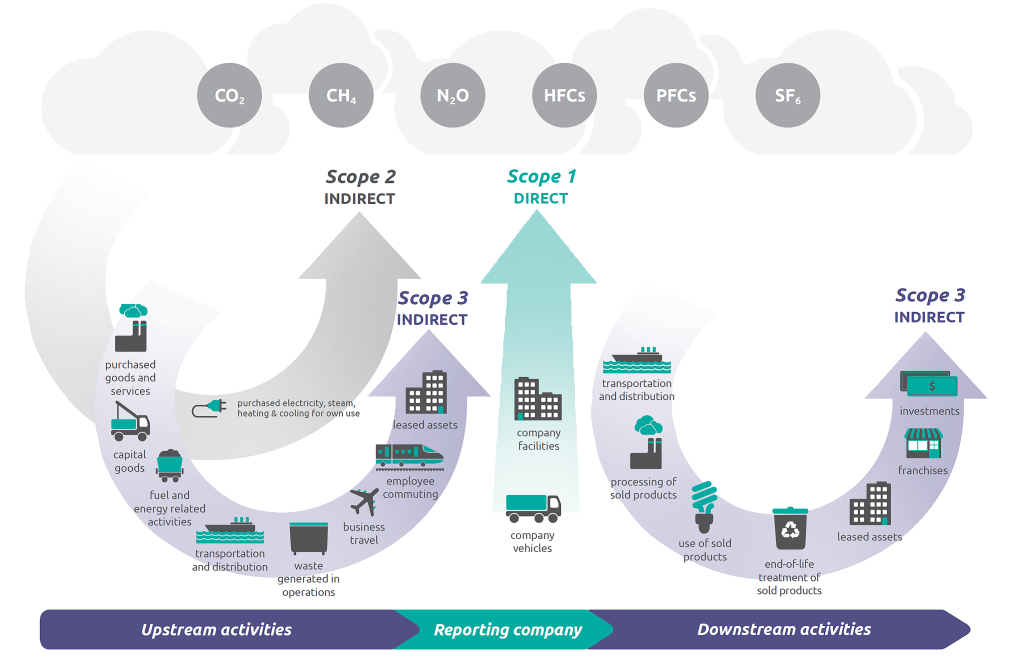
Greenhouse Gas Protocol (10)
‒ Scope 1 includes direct emissions by sources owned or controlled by an organization
‒ Scope 2 includes indirect emissions resulting from
the generation of electricity, heat, or steam that an organization purchases.
‒ Scope 3 includes all other indirect emissions from upstream and downstream activities.
Life Cycle Assessment
The second method is the life cycle assessment (LCA), where assessments can be certified to ISO 14067. An LCA measures the environmental impact per unit of the final product, taking into consideration the impact on different metrics. The LCA process considers various stages from ‘cradle to gate’—which includes raw materials to processing—as well as ‘cradle to grave,’ which extends to the product’s end of life.
Leveraging LCA for Petfood
Where GHG accounting fulfils legislative requirements, an LCA is a powerful tool to communicate to investors and customers the benefit of their sustainability efforts in quantifiable terms.
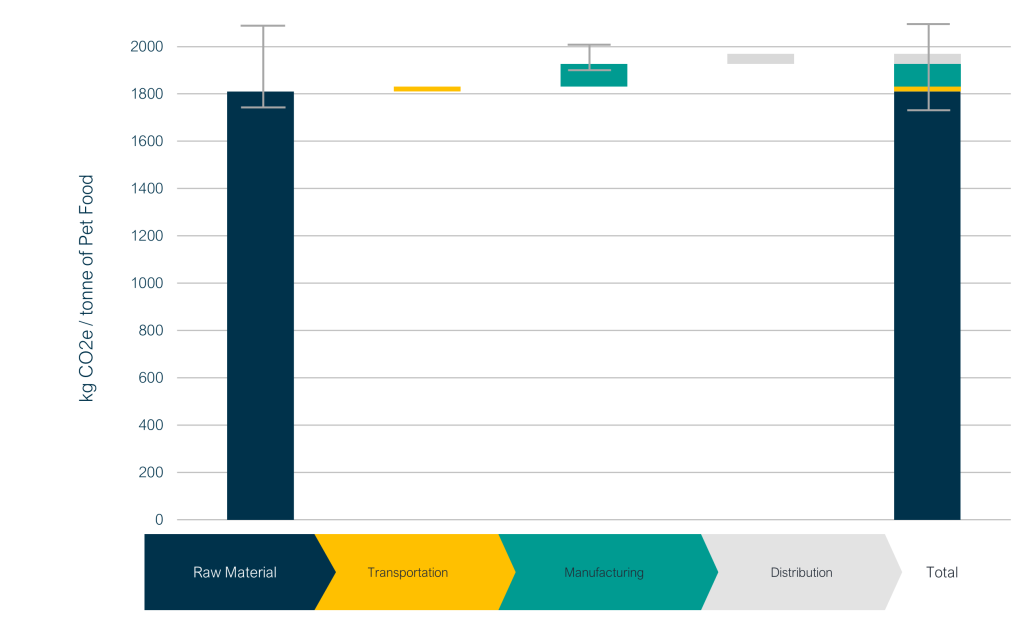
Figure 2 shows the typical CO2 footprint of petfood. The raw materials consist of the following: animal protein meal, cereals with varying fibre content, fat and vitamins. The exact figure will change depending on several factors, in particular:
- ‒ Raw materials production, yield, and recipes
- ‒ Drying, cooling/heating or heat-treating
- ‒ Long-distance logistics by truck
- ‒ Packaging is key in waste reduction
Reduce the environmental footprint in the Petfood value chain
Using LCA and GHG protocol methodologies helps make fact-based decisions and quantify the impact of reduction measures to prioritise the solutions with a return of investments and to access financial incentives.
1. Reduce Scope 1 & 2 Emissions
This section presents key cost-effective measure to cut down on energy use and emissions.
Reduce Scope 1 emissions:
‒ Prioritise the reuse of waste heat from manufacturing processes. When products are dried after extrusion, waste heat should be recovered and upgraded with retrofits such as heat pumps to reduce energy use, costs and emissions. Emissions can be reduced up to 45 percent and thermal energy savings up to 30 percent.
Reduce Scope 2 emissions:
‒ Ensuring efficient machinery for increased performance and energy optimisation. Given that most Scope 2 emissions come from manufacturing, solutions such as a modern hammer mill can minimise the footprint. The Granulex hammermill can enable energy savings up to 30 percent in the grinding process.
‒ Ensure the equipment around the processes are up to date (e.g., LED lights).
‒ Use smart sensors to measure energy consumption across the manufacturing process (e.g., avoid energy spikes, minimise machine idling times). The company’s DryingPro can reduce up to six percent of the energy consumption during the drying process and optimise the yield by up to 10 percent.
“Bühler’s DryingPro service enables us to sustainably improve the high-quality standards we set for product quality and the environment. Thanks to active drying control, we have been able to reduce moisture fluctuations in our end products by 60% and realize energy savings of 35%.” by Werner Bobach Production Manager Interquell, Germany
Efficient production through optimal planning, intelligent routing, and automation minimises Scope 1 and 2 emissions. Optimised maintenance reduces energy use by up to 10 percent. Continuous optimisation is available via the company’s performance assessment workshops (PAW) carried out by its experts (TotalCare).
Renewable Energy
Using renewable energy further reduces Scope 2 emissions to zero and Scope 3 emissions of energy production close to zero, vital for achieving Net-Zero. Methods to increase renewable energy use include:
- On-site production (e.g., solar panels).
- Purchasing renewable energy certificates.
- Developing power purchase agreements (PPAs).
These different renewable methods have varied benefits and drawbacks. On-site production offers clean energy with medium-term ROI but may not meet full energy requirements. PPAs create new infrastructure and stabilise long-term energy prices but have availability and lead time constraints. For more information on PPAs, click here
Renewable energy certificates, despite criticisms, help cover remaining energy needs not met by PPAs or on-site production. Transparent reporting of the renewable energy strategy should include kWh consumed, kWh reduced, and both location-based and market-based CO2.
2. Reduce Scope 3 Emissions
As shown in Figure 2, the raw materials can comprise up to 92 percent of the footprint of petfood and can be constituted of animal protein meal, high and low fibre cereals, fat and vitamins. To address this key aspect, it is essential to sustainably procure raw materials for petfood.
Constituent variability with insects
The raw materials for petfood vary based on sustainability, hypoallergenic properties, nutritional value, and palatability. As agricultural emissions and land use must be disclosed and reduced, alternative raw materials are gaining traction. Producers and value chain partners downstream are beginning to incorporate insects as a primary constituent in petfood, replacing animal and bone meal. With insect meal CO2 emissions can be reduced up to 30 percent.
Sustainability and Industry Collaboration
Joint efforts across sectors are crucial for effective climate action. Bühler Group and Improvin’ exemplify this by creating a platform to help food producers calculate and report carbon footprints. More information in Bühler’s press release. Globally, numerous partnerships form networks committed to sustainable practices, driving innovation and fostering a culture of sustainability.
Conclusion
Governments and companies are racing towards 2030 to reduce carbon emissions and limit global warming to 1.5°C. The petfood industry plays a pivotal role in this effort. Quantifying environmental impacts through environmental metrics will provide data-driven insights, creating competitive advantages and profitable sustainability. When sustainability is profitable, it will create impact at scale.
Published in September 2024 edition of International Petfood Magazine
Bibliography
- European Commission. Corporate Sustainability Reporting Directive. [Online] January 5, 2023. [Cited: March 4, 2024.] https://finance.ec.europa.eu/capital-markets-union-and-financial-markets/company-reporting-and- auditing/company-reporting/corporate-sustainability-reporting_en.
- U.S. Securities and Exchange Commission. SEC Adopts Rules to Enhance and Standardize Climate- Related Disclosures for Investors. U.S. Securities and Exchange Commission. [Online] March 6, 2024. [Cited: March 18, 2024.] https://www.sec.gov/news/press-release/2024-31.
- Science Based Targets Initiative. Companies Taking Action. Science Based Targets. [Online] [Cited: March 22, 2024.] https://sciencebasedtargets.org/companies-taking-action#anchor-link-test.
- WBCSD. WBCSD steps up the course for systemic business transformation. [Online] World Business Council for Sustainable Development, October 28, 2021. [Cited: June 6, 23.] 8. https://www.wbcsd.org/Overview/ News-Insights/General/News/WBCSD-steps-up-the-course-for-systemic-business-transformation.
- The global environmental paw print of pet food. Alexander, Peter, et al. s.l. : Global Environmental Change, 2020, Vol. 65.
- Pet Food in the US, 17th Edition. Freedonia Group. [Online] 2023. [Cited: March 8, 2024.] https://www. freedoniagroup.com/packaged-facts/pet-food-in-the-us.
- Securities and Exchange Commission. In the Matter of the Enhancement and Standardization of Climate- Related Disclosures for Investors. [Online] April 4, 2024. [Cited: April 12, 2024.] https://www.sec.gov/files/rules/ other/2024/33-11280.pdf.
- Science Based Targets Initiative. Lead the way to a low-carbon future. Scienced Based Targets. [Online] [Cited: March 11, 2024.] https://sciencebasedtargets.org/how-it-works.
- [Online] https://climateactiontracker.org/global/temperatures/.
- GHG Protocol. Greenhouse Gas Protocol. [Online] [Cited: June 6, 2023.] https://ghgprotocol.org/.
- Greenhouse Gas Protocol. The Corporate Value Chain (Scope 3) Accounting and Reporting Standard. 2011. p.5.
- International Standards Organisation. Greenhouse gases — Carbon footprint of products — Requirements and guidelines for quantification. International Standards Organisation. [Online] 2018. [Cited: June 6, 2023.] https://www.iso.org/obp/ui/#iso:std:iso:14067:ed-1:v1:en. 14067.
- Thixton, Susan. What Is The Most Commonly Used Pet Food Ingredient? Truth about Pet Food. [Online] March 16, 2020. [Cited: March 8, 2024.] https://truthaboutpetfood.com/what-is-the-most-commonly-used- pet-food-ingredient/.
- United Nations. For a livable climate: Net-zero commitments must be backed by credible action. United Nations. [Online] 2022. [Cited: March 11, 2024.] https://www.un.org/en/climatechange/net-zero-coalition.
- New Climate Institute. Corporate Climate Responsibility Monitor. 2023.
- The edible insect sector in Canada and the United States. Larouche, Jennifer, et al. 4, Animal Frontiers, Vol. 13, pp. 16-25.
- The environmental sustainability of insects as food and feed. A review. van Huis, Arnold and Oonincx, Dennis G.A.B. s.l. : Agronomy for Sustainable Development, 2017, Vol. 37, pp. 1-14. 43.
- FAO. FAOSTAT. Rome : Food and Agricultural Organisation, 2021.