by John Harvey, Veterinary Surgeon and MSc Student, University of Exeter;
Dr Peter Alexander, Senior Lecturer in Global Food Security & Prof. Dominic Moran, Professor of Agricultural and Resource Economics, University of Edinburgh
Despite accounting for around 30 percent of global greenhouse gases, emissions from food systems have not received as much political attention as those from energy, transportation, and other industrial sectors. But that changed at COP28, where the final agreement made specific reference to food.
Taking a leaf out of the ‘big oil’ playbook, there has been some push-back from ‘big meat’, but it now seems inevitable that food systems will eventually be included within national emissions allowances; and this is likely to have direct and indirect consequences for pet food production as a subsidiary part of that system. What might these be and how might related environmental impacts be mitigated?
In terms of direct effects, the trends that we see in human food consumption, largely away from meat and ultra-processed foods, will likely be mirrored in pet food sector. Consumer preferences can change rapidly, and growing consumer awareness of climate change and other sustainability challenges will be reflected in the choices they make or themselves and their pets. Changing demand will in turn drive more sustainable pet food compositions.
In addition, an on-going protein transformation of the human food system, mainly away from red meat, will likely have indirect impacts for pet food producers. Changing patterns of meat production will influence the production costs and supply of animal by-products (ABPs), often used as pet food ingredients. Other potential policy interventions in the meat and livestock sector could include a meat tax and a variety of voluntary or mandatory measures to reduce meat in public procurement for schools, hospitals and other public bodies. Such measures will also have an indirect effect on livestock production, and in turn, the likely availability of ABPs. ABP prices could also be driven up by increased use in human diets or alternative competing uses such as for manufacture of pharmaceuticals, biodegradable plastics, or biofuels.
Can pets be fed in environmentally friendly ways?
There is currently considerable debate about how pets can be fed in a more environmentally friendly way. A simple approach might be to encourage ownership of fewer and smaller pets. Feeding dry instead of wet food has been suggested to have a significantly lower carbon footprint. Some also argue that a move to plant-based diets is essential for environmental sustainability, and healthy for pets; the potential for nutritional completeness of plant-based foods now being accepted, at least for dogs, by some mainstream veterinary nutritionists. Others maintain that ABPs are still a low waste protein source with less climate impact. The veterinary profession, meanwhile, has health concerns about plant-based pet feeding, especially for cats. Elsewhere, proponents of insect-based foods highlight their sustainability attributes. Advocates of more raw food or ‘natural’ diets, typically with high meat content, argue that ingredients can be sourced in a more ethical and environmentally friendly way. While there is little evidence to support the environmental benefits of the latter, these arguments suggest that a common position on pet feeding sustainability performance metrics has not been reached.
Consumer interest in sustainable pet foods is growing, from a historically low level, and ingredient sourcing as a product sustainability attribute is a focus of industry research and innovation. This includes research to understand consumer preferences for ABPs as healthy and sustainable protein sources. It seems clear that consumer demand will increase through better information about ingredients, primarily better labelling – detailing content percentages rather than generic descriptions of ‘meat and animal derivatives’. This suggests that labels should initially provide information beyond current regulatory requirements.
Trust in labelling is a key product attribute. Unilever are currently being investigated for ‘a range of concerning practices’ including possible misrepresentation of product sustainability credentials.
Might petfood come under similar scrutiny?
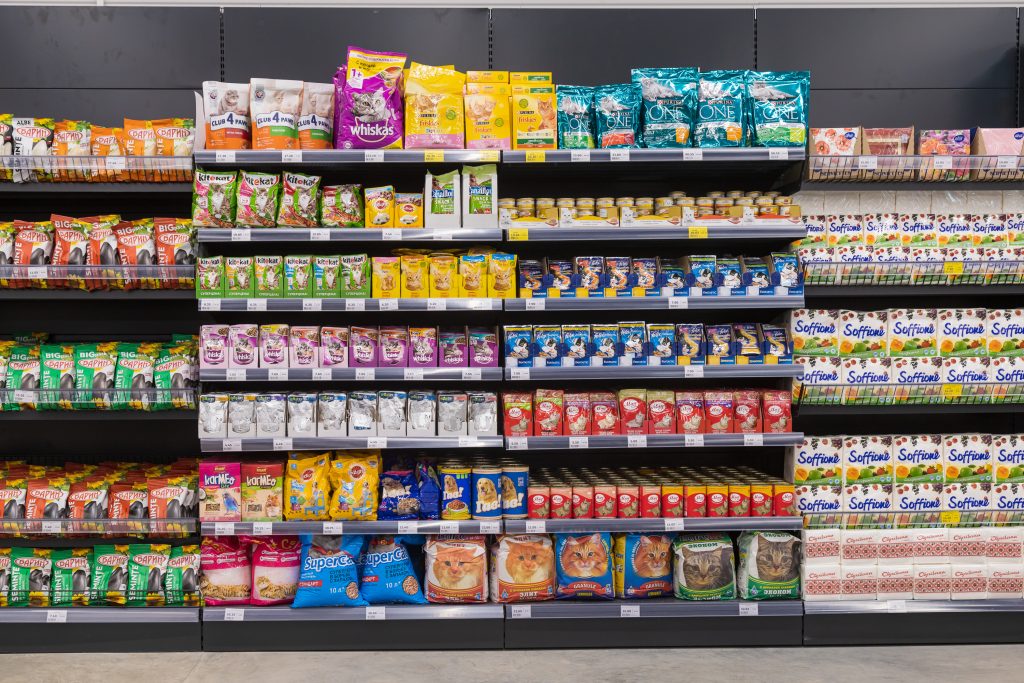
Reconnaissance in one supermarket showed two ‘premium’ pet food products from one manufacturer being separately marketed for health and improved sustainability but with almost identical ingredients. Previous studies have suggested that ‘main market’ products generally have lower environmental impacts than the ‘premium’ segment, due the quantity of the meat content. This could be the case here, although it would be hard to assess as the manufacturer only lists ‘meat and animal derivatives’ as the ingredients of their main-market branded product. Might regulators regard this as ‘misleading’? Either way, more transparency of ingredients would be a positive step.
The biggest players in the pet food industry are gaining experience offering plant-based and alternative protein, including insect, recipes. This includes purchasing or launching ‘niche’ brands, adding such products into their main ranges, and including plant-based recipes in their main offerings without specifically promoting this feature (for example Purina HA hypoallergenic which is vegan except for fish oil). At the same time, market demand for high-meat diets is met under alternative branding from the same companies. It seems likely that major players have the expertise, brands and supply chains that would allow them to adapt rapidly to market demand or ingredient supply changes. However, this might be different for smaller manufacturers who may have a smaller range of brands. They also may struggle to adapt formulations or may face supply chain challenges, especially accessing ingredients (such as alternative proteins), which may not be available through established agricultural practices.
Ingredients are only part of the sustainability picture. As environmental impact assessments improve, ingredient sourcing, animals (or insect) feeding, transportation, packaging, storage (e.g. cold chain) requirements, and other factors will come under increasing scrutiny. As with human food supplies, the development of life cycle assessment (LCA) methodologies (for example foundation-earth.org) will likely evolve into standardised front of pack ecolabels.
Lack of clarity
At present, the environmental impacts of different pet feeds are still disputed. But the scale of the global impact of pet food is substantial. Impacts related to ingredients are estimated as 56-151 Mt CO2 annual global emissions (dry food alone) – equivalent to 6-17 percent of aviation emissions. Variation in estimates arise when determining the ingredients of different products, grouping a wide range of ingredients as having similar impacts (for example treating all meat as chicken), and disagreements in attributing environmental impacts to ABPs.
The correct calculation of ABP impacts is still unresolved. Currently, LCA of ABPs apportions their impacts in proportion to their economic contribution to carcass value. This results the assignment of a relatively low environmental impact. But an alternative approach would be to assign the same environmental impacts, by weight, to other parts of the carcass. To understand the impacts of ABPs as pet food ingredients, it is insightful to consider what would happen if they were not used in pet food; that is, considering the likely changes would then occur in the food system and the associated the environmental impacts of alternatives. For example, if ABPs would otherwise be waste that had to be incinerated, with little impact on the number of animals produced for meat, use in pet food would be very positive environmentally. On the other hand, if ABP use in pet food is economically supporting increased meat production, the impacts might be far greater.
There are gaps in the research evidence on the sustainability of pet foods. An increasing focus on food chain sustainability metrics is likely to extend to increased scrutiny of the pet food sustainability claims. Changes in consumer preferences as well as changes to ingredient supply linked to market and regulation pressures seem likely. In the coming years, the pet food industry will evolve due to sustainability pressures. How quickly this occurs, what this means for businesses along the supply chain, and the costs to consumers who may already be experiencing a ‘cost of living crisis’, are key future challenges for the industry.